
Kronborg Castle: Explore Hamlet’s Castle in Elsinore, Denmark
Whether you’re a Shakespeare fan or you simply love historic castles, you should add Kronborg Castle in Elsinore to your list.
In this post, I’ll explain where Kronborg is, how to get there, what to see, and – of course – what the connection to Hamlet is.

This post may contain affiliate links and I may receive a commission, at no extra cost to you, if you make a purchase through a link. Please see my disclosures.
Kronborg Castle: Quick Facts
Where is Kronborg Castle?
Kronborg Castle is located in the Danish city of Helsingør, usually called Elsinore in English. The castle overlooks the Øresund (the Sound), a strait separating Denmark and Sweden.
In Helsingør, at the northeastern tip of the Danish island of Zealand, the Øresund is at its most narrow. It is only 2.5 miles (4 kilometers) wide.
This means that you can see Sweden from Kronborg Castle. It also means that the castle, with its impressive array of cannons, was able to control ships moving through the Sound.
And this prime location is the reason that the castle is so important.

A Brief History
King Eric VII built a fortress called Krogen (“the Hook”) on the site in the 1420s. Then King Frederik II expanded it into a Renaissance castle in the 1570s and 1580s and called it Kronborg (“Crown Castle”).
The Danish kings instituted a toll, the Sound Dues, on all foreign ships passing through the Sound. Since the Sound is one of the main waterways connecting the Baltic Sea and the North Sea, there were a lot of ships.
The kings made a lot of money off the Sound Dues. So you can see why maintaining control of Kronborg Castle was important!
Frederick II and his wife Sophie lived in the castle and threw wild and sumptuous parties. Their fame spread all over Europe and inspired William Shakespeare to set his play Hamlet at Kronborg. But more about that below!
Getting to Kronborg Castle
It is quite easy to get to Helsingør by train. If you are coming from Copenhagen, then you can catch a direct regional train from Copenhagen Central Station (København H).
Trains run every 15 minutes. Simply consult the overhead screens at the station to determine which platform you should go to. Helsingør is the last stop, so look for “Helsingør” on the screens.
If you have the Copenhagen Card, no need to pay or check in. Just hop on board and then show your card if train staff ask for it. But if you do not have an active Copenhagen Card, you will need to purchase a ticket at the station.
The ride will take about 45 minutes. When you step outside Helsingør Station, bronze statues of Hamlet and Ophelia greet you.
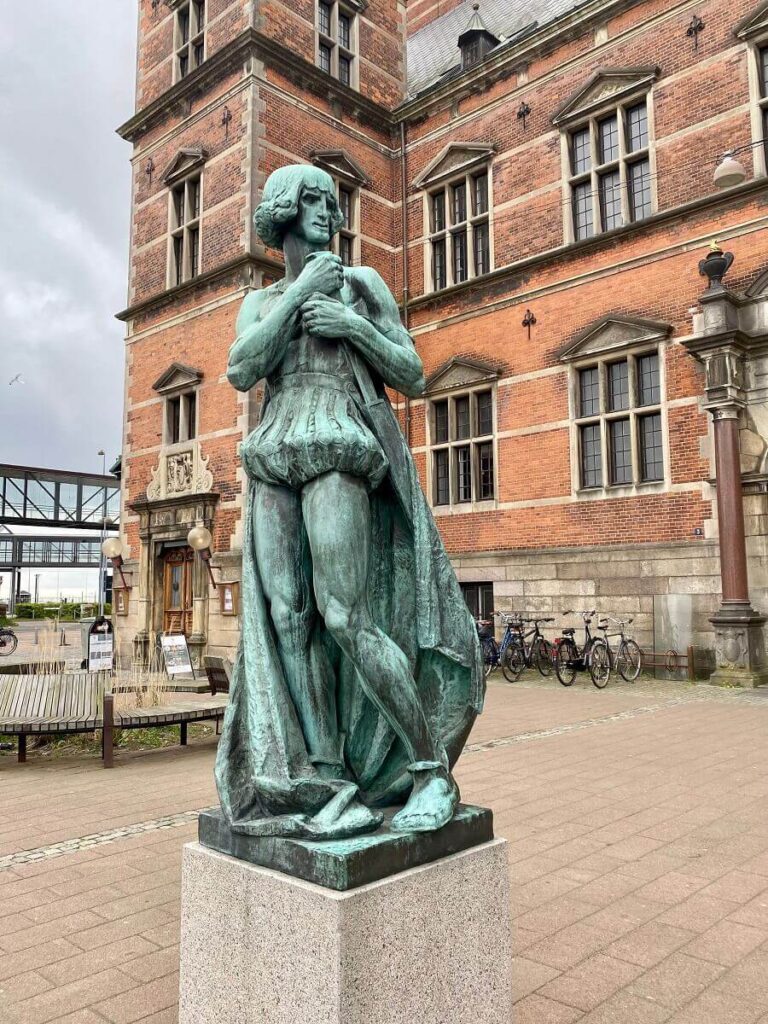

Kronborg Castle itself is also visible in the distance, so you won’t get lost. It’s a 10-15 minute walk, depending on your pace.
The easy access via train makes Kronborg an excellent day trip from Copenhagen. Note: if you are coming from somewhere other than Copenhagen, use this incredibly helpful site to find the best train route.

Tips for Visiting Kronborg Castle
- Admission price: DKK 125 for adults, free for children under 18; free with the Copenhagen Card
- Castle opening hours: 10:00 – 5:00 daily from May to October; otherwise 11:00 – 4:00 Tuesday through Sunday
- Parking: DKK 14 per hour, 10-minute walk from the castle
- Wifi: yes (although it didn’t work well for me)
- Cloakroom: free lockers are available for coats and bags
- Visit Kronborg’s official website
You will cross the castle moat via a bridge and then walk through a gate in the outer defensive wall. Note that there are restrooms immediately to your left, inside the wall. They are easy to miss if you aren’t looking for them. Don’t worry – more restrooms are available inside the castle itself.
If you have the Copenhagen Card, you can head straight for the castle entrance. Otherwise you need to stop at the ticket office. They will give you a handy map along with your ticket.
At the castle entrance you can scan your ticket and then head inside to explore. The coatroom is immediately to your right when you enter. We happily locked up our backpacks so we didn’t have to carry them around everywhere.
Pro Tip: Free guided tours are offered daily year-round in Danish or English. We didn’t take a tour because the times didn’t work out for us, but they sound excellent. The tour times for each day are listed on the black chalkboard immediately inside the castle courtyard.
Food & Drink: The castle itself has a café, but if you want a more substantial meal you can head to Kadetten. This restaurant is within the outer wall and the moat; it’s about a 5-minute walk from the castle. I had a delicious smørrebrød (Danish open-faced sandwich) there.

What To See At Kronborg Castle
Kronborg has various rooms open to the public. You can also walk around the battlements and the surrounding land. Here are some of the best things to do at Kronborg!
Visit the Royal Apartments
The Royal Apartments suffered greatly in a great fire in 1629, so they have mostly lost their original sumptuous decorations. But you can see 7 of the royal tapestries originally commissioned by Frederick II.
You can walk through rooms where the 14-year-old Danish princess Anna and her new husband James VI of Scotland stayed after their wedding in 1589. They would later become king and queen of England after Queen Elizabeth died childless.
The castle also served as a gilded prison in 1772 for the disgraced Danish Queen Caroline Mathilde. She was accused of having an affair with her husband’s physician and was promptly exiled and divorced. (In the past Danish queens had numerous supposed affairs, and Danish kings tended toward insanity.)

Admire the Chapel
The chapel survived the fire that ruined the Royal Apartments. This means that here you can get a glimpse of the original Renaissance decoration.
Pay special attention to the coffered wooden ceiling when you enter the chapel. The Royal Apartments once had this beautifully carved decoration, too!
Explore the Casemates
My favorite part of Kronborg Castle is underneath. Today Denmark and Sweden are at peace, but in the past the two Scandinavian countries waged bitter wars for control.
Kronborg was an important part of Danish protection, and for this reason under the castle you can find the casemates. These rooms and tunnels served as living quarters for soldiers during a siege and as a place to store weapons and food.


Descend into the dark tunnels and wander around, imagining what life would have been like for a 16th or 17th-century castle inhabitant. And – most importantly – say hi to Holger the Dane.
Pay Respects to Holger the Dane
In the casemates sits Holger the Dane, a great Danish hero. He is asleep now, but when Denmark is in danger he will arise again to save his country.
Holger the Dane is the first thing you see when you enter the casemates. A life-sized statue shows a mighty warrior seated with his sword across his lap. Lights flicker and in the eerie underground, it is easy to believe that he is simply sleeping.

Holger the Dane is a major part of Danish legend, but it was not until 1846 that he became associated with Kronborg. Hans Christian Andersen wrote a tale about him and his fated return.
[The little boy] saw in his dreams the Sound and Elsinore Castle with old Holger the Dane sitting down in the dark cellar, where he dreamed about everything that happened in all of Denmark. . . . Holger mumbled in his sleep, where he nodded his head: “Yes, do not forget me, Danes. Remember me! I will come when you are in need.”
Hans Christian Anderson, “Holger the Dane”, trans. Haugaard
You can read the full fairytale in this anthology of Andersen’s stories. But whether you know the story or not, Holger the Dane will impress you. The current statue has stood under the castle for over 100 years.
Admire the View from the Battlements
After you have explored the inside of the castle, it’s time to walk around outside. Turn right when you exit the castle entrance and head up to the battlements.
A row of cannons sits there, a reminder that Kronborg enforced payment of the Sound Dues by ships passing through the strait. But, more importantly, you can receive a lovely view of the sound and of Sweden across the water.


When we were there, we also saw people fishing in the sound and locals walking and exercising all around the castle. You have to pay to enter the castle itself, but the surrounding grounds and island are accessible to the general public.
As I walked around the outer walls, I thought about Hamlet and his encounter with his father’s ghost. And this leads me to the next section of this post.
Hamlet & Kronborg Castle
Although Kronborg is historic in its own right, a great deal of the attention the site receives comes from the association with Shakespeare’s famous play Hamlet.
Shakespeare tells the tale of Hamlet, Prince of Denmark, and the play takes place at Kronborg Castle. You may ask: why is Kronborg Hamlet’s castle? Is Hamlet a true story? Here are your answers.
Was Hamlet real?
Hamlet is based on the Danish prince Amleth. Amleth likely wasn’t a real person, but he was part of Danish legend. The primary account of his adventures comes from the Danish historian Saxo Grammaticus, who wrote 16 books in Latin about the history of Denmark.
This work, the Gesta Danorum or History of the Danes, is still an important source for historians and lovers of Norse mythology. It dates to the early 13th century, and the story of Amleth is possibly centuries older.
In Saxo Grammaticus’ version, Amleth is the son of the king of Jutland (a peninsula now part of modern Denmark). His uncle Feng kills his father and marries his mother, Gerutha. Amleth pretends to be a fool in order to protect himself, but meanwhile he plans his uncle’s death.
It is easy to see where Shakespeare got his basic plot. We don’t know if he had access to Saxo Grammaticus himself, but French and English adaptations were circulating in Shakespeare’s time.
If you are interested in the origins of Hamlet, take a look at The Norse Hamlet. This book includes the Amleth portions of Saxo Grammaticus as well as an English adaptation of Amleth’s story.

Why is Kronborg Hamlet’s castle?
In the earliest Danish accounts, Amleth is prince of Jutland. And Kronborg Castle is on the island of Zealand. Not to mention that Kronborg Castle wasn’t built until the 16th century – hundreds of years after Amleth supposedly lived.
So it is safe to say that Amleth, the legendary Danish figure, did not reside at Kronborg. Why, then, does Shakespeare choose Kronborg to be Hamlet’s castle?
As I mentioned earlier in this post, King Frederick II of Denmark expanded Kronborg greatly in the late 16th century. He and his queen then proceeded to host parties famed all over Europe.
It seems that Shakespeare heard about these parties and decided that Kronborg was the perfect setting for the tragedy of Hamlet, prince of Denmark. He wrote Hamlet sometime between 1599 and 1601 . . . and the rest is history.
Scholars believe that Shakespeare himself never visited Kronborg, but that many of his actors did. So Shakespeare likely received first-hand accounts of the Danish royal castle.
Although Amleth had no connection to Kronborg, Shakespeare’s Hamlet has always resided there. And that’s why Kronborg is a must-visit site for drama-lovers!

Plan Your Visit To Kronborg Castle
Now you know how to get to Kronborg and what to do there. You also know why this castle is considered to be Hamlet’s. So, what are you waiting for? Add Kronborg to your list.
This historic castle has played an important role in Danish history (and in world literature). This has earned it the title of UNESCO World Heritage Site. Plus it has a gorgeous location on the strait between Denmark and Sweden. What’s not to like?
Looking for other European destinations? Visit my Explore Europe page!
YOU MAY ALSO LOVE:

I will definitely have to put this on my bucket list after looking at all these recommendations; brilliant article!
I’m so glad you enjoyed the article, Ella! I hope you have a chance to visit Kronborg 🙂