
Georgia Guidestones & More: Why to Visit Elberton
Elberton, Georgia is a small town like no other. From the mysterious Georgia Guidestones to an exhumed Confederate statue, this town will intrigue and charm you.
At first glance, Elberton may seem like a boring country town. The population is less than 5,000, and Elberton sits in the middle of nowhere in Elbert County, Georgia. It’s about 20 minutes from the Georgia-South Carolina border (and just under 2 hours from Atlanta).
But Elberton is a reminder that you can’t judge a book by its cover. The town is home to one of the weirdest roadside attractions in north Georgia – the Georgia Guidestones, sometimes called the American Stonehenge. And, beyond that, Elberton is known for being the Granite Capital of the World.
In this post, I’ll tell you everything you need to know about the Georgia Guidestones and how to visit them. But I won’t stop there, since there are other fun things to do in Elberton, GA. Read on to discover why you should visit Elberton and what to do there.
And if you need convincing – almost everything I list here is free! Elberton is the perfect budget destination.
Georgia Guidestones
What are the Georgia Guidestones?
On a deserted hillside 9 miles north of the Elberton city center looms a large granite monument. It stands on the highest land in the county, and it reaches a total height of 19′ 3″. Four vertical slabs surround a central stone and support a horizontal capstone.

A nearby plaque in the ground details the monument’s physical measurements and mentions a time capsule (which was probably never actually buried). The plaque also supplies astronomical information about the stones’ placement. Apparently, the monument has three astronomic features:
- A channel through the central stone indicates the celestial pole.
- A horizontal slot in the central stone indicates the annual travel of the sun.
- A sunbeam comes through the hole in the capstone at noontime every day throughout the year.

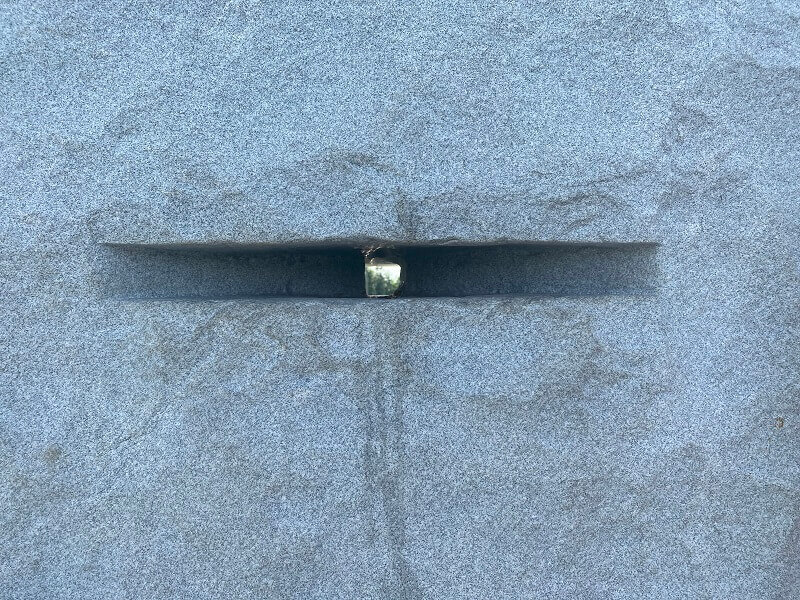
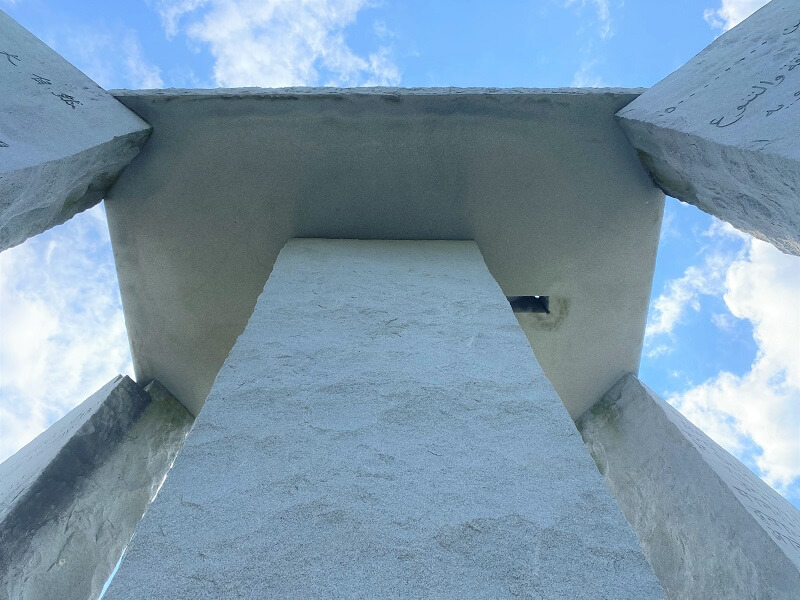
The vertical slabs contain 10 guidelines inscribed on them in eight modern languages: English, Russian, Chinese, Arabic, Hebrew, Hindi, Swahili, and Spanish.
The capstone has the message “Let these be guidestones to an age of reason” written in four ancient languages: Ancient Greek, Akkadian, Sanskrit, and Ancient Egyptian.

Since I am an avid language learner, the multilingual nature of the monument was part of the attraction for me. But even if English is your only language, you will soon find yourself sucked into the mystery.
Who made the Georgia Guidestones?
The Georgia Guidestones were erected in 1980, but their ultimate purpose remains unclear. Here is what we know: a man using the name R. C. Christian approached Joe Fendley, president of the Elberton Granite Finishing Company, and explained that he represented a “small group of loyal Americans” from outside Georgia. Christian outlined their vision for the Guidestones and did not baulk when Fendley quoted him an extremely high price.
According to wired.com, R. C. Christian was forced to reveal his true name to the town banker, Wyatt Martin, for financial purposes. But Martin had to sign an agreement stating that he would never disclose the secret.
For the last 40 years, Martin has stayed true to his word. So no one knows, and likely no one will ever know, who the “loyal Americans” are behind the Guidestones.
Once Martin had confirmed Christian’s ability to pay, Fendley and Elberton Granite built the impressive monument according to Christian’s specifications. They had to consult with an astronomer from the University of Georgia to create the astronomical features.

What do the Georgia Guidestones say?
The 10 guidelines deal mostly with the preservation of the earth, but some come dangerously close to advocating for a eugenics program. I read the English, Spanish, and Russian versions in fascination. The text is as follows:
Maintain humanity under 500,000,000 in perpetual balance with nature
Guide reproduction wisely improving fitness and diversity
Unite humanity with a living new language
Rule passion – faith – tradition and all things with tempered reason
Protect people and nations with fair laws and just courts
Let all nations rule internally resolving external disputes in a world court
Avoid petty laws and useless officials
Balance personal rights with social duties
Prize truth – beauty – love seeking harmony with the infinite
Be not a cancer on the earth – leave room for nature – leave room for nature
The Georgia Guidestones
Of course, the first guideline is a bit odd, considering that we already have far more than 500 million people on earth. We are at over 7.8 billion, more than 15 times the population specified on the Guidestones.


What does this mean? What is the point of these injunctions? The capstone only says that they should serve as a guide to an age of reason.
Theories about the Georgia Guidestones
Understandably, many theories have arisen over the years. Some people hate the stones and believe that they are satanic. Others argue that they represent the agenda of a “New World Order” that intends to dominate the earth. The Guidestones have suffered vandalism several times.
The theory that makes the most sense to me is that the Georgia Guidestones are meant to guide human survivors after an apocalypse. After all, the Guidestones date back to 1980, when the US and the Soviet Union were in the midst of the Cold War. Back then, nuclear war was a real threat.
This explanation would account for the command to maintain humanity under 500 million. After a nuclear war or similar catastrophe, there wouldn’t be many humans left. Furthermore, perhaps the astronomic features are meant to aid in the rediscovery of lost arts. As an article in CNN puts it, the features “would allow the survivors of Christian’s feared apocalypse to reproduce three of the basic tools of civilization: the calendar, clock and compass.”
Now that you know all about the Georgia Guidestones, let’s move on to how you can visit them – and Elberton.
How to visit the Georgia Guidestones
The Guidestones now belong to Elbert County and you can visit them free of charge. There is a small parking lot next to the site, which is surrounded by a chain link fence. On the day we visited, a few motorcyclists stopped by to examine the stones, but other than that we had the place to ourselves.
(Note that when I say we had the place to ourselves, I mean it literally. There is no visitor center or anything, just the Guidestones. So if you visit on your own, keep an eye on your surroundings and be safe.)
We enjoyed strolling around and admiring the monument. There is a sign with information about the site, and then of course the plaque that I mentioned before with astronomical specifications. And at the bottom of this plaque is a note saying “Additional information available at Elberton Granite Museum & Exhibit.”
We had some free time, so we decided to go to the granite museum. And I’m so glad we did! Visiting Elberton itself helped us to understand the context of the stones, not to mention we learned about another intriguing tale – that of Dutchy.
Things to Do in Elberton, GA
When you enter Elberton, you will see a proud sign stating that Elberton is the “Granite Capital of the World.” And indeed, granite is visible everywhere. Granite warehouses line the roads, and granite products are used for everything. All the businesses, from the hair salon to the bank, have granite signs. We even spotted some granite mailboxes!
In fact, Elberton produces more granite monuments than any other city in the world. According to the brochure I picked up in the museum, there are 45 granite quarries, 150 granite manufacturing plants, and 1800 granite industry employees in the area.
Why all this granite? Well, Elberton is sitting on a deposit of granite 35 miles long, 6 miles wide, and 2-3 miles deep.
So this is why R. C. Christian chose Elberton for the location of the Georgia Guidestones. He knew Elbertonians were experts at granite design, and he thought Elberton granite was beautiful.
And now let’s look at the best things to do in Elberton, GA!
Elberton Granite Museum


Our first stop after the Guidestones themselves was the Elberton Granite Museum, run by the Elberton Granite Association. The museum is small but packed with information. You can watch a 15-minute video about the history of the granite industry in Elberton and see exhibits with craftsmen’s tools from the last 100 years.
I learned all kinds of fun facts. For instance, did you know that they use diamond-edged saws to cut granite? It makes sense, since diamond is one of the only materials harder than granite. But still cool!
A FEW NOTES
- Admission to the museum is free. I told you that this was a low-cost adventure!
- According to the Elberton Granite Association website, the museum is open from 2 to 5 pm Monday through Saturday. However, if you are in the area earlier in the day, swing by anyway. We visited at 11 am and there was a volunteer there, so the museum was open.
- At the museum you can pick up free postcards and brochures about Elberton, granite, and Dutchy. You can also buy souvenirs – granite doorstops and paper weights.
Dutchy
The highlight of the Elberton Granite Museum is Dutchy, a granite statue of a Confederate soldier that dates from 1898. Many Elbertonians fought for the Confederacy in the American Civil War, so the community wanted to honor the Confederate dead. They decided to erect a monument of a Confederate soldier, and they built Elberton’s very first granite finishing plant for the specific purpose of fashioning this statue.
But the statue they raised in the town square caused great consternation. Confederate veterans thought the statue looked like a Union soldier and like a short Dutchman. Hence the derogatory nickname Dutchy arose.

In 1900 some frustrated veterans tore Dutchy down, “lynched” him, and buried him where he fell. It was only in 1982 that Elberton decided to dig up the statue from under the town square.
Now Dutchy is a source of pride for the community. He lies in the Elberton Granite Museum, where you can pick up a brochure to learn more about his tumultuous history.
And, even though Dutchy only graced the town square for two years, he was the start of Elberton’s booming granite business. So Elberton owes a lot to Dutchy!
Elberton Town Square
Make sure you stop by Elberton’s town square. You can admire the Elbert County Courthouse, built in 1893, as well as a beautiful granite fountain. The sides of the fountain detail the history of Elberton and Elbert County.

You can also see Dutchy’s replacement – the current monument to Confederate dead. It always shocks me how many Confederate monuments remain in rural Georgia.
Old Dan Tucker’s Grave
Elberton is home to Dan Tucker’s Grave. Have you ever heard the American folk song about Old Dan Tucker? I remember it from reading Laura Ingalls Wilder’s Little House on the Prairie series when I was young.
Old Dan Tucker was a fine old man
Opening lines of “Old Dan Tucker”
Washed his face with a fryin’ pan
Combed his hair with a wagon wheel
And died with a toothache in his heel
The song continues on in that vein – if you have never heard it, you should look it up. In any case, it turns out that Dan Tucker was a real individual, a preacher who lived in Elberton in the early 1800s. Unfortunately, I didn’t have time to stop by his grave myself when I was in the area, but I would love to visit in the future! There is no cost, so why not?
Richard B. Russell State Park
If you want to enjoy some of northeast Georgia’s beautiful nature, then head out to Richard B. Russell State Park. You can enjoy hiking, fishing, swimming, geocaching, and disc golfing, among other things. There is a $5 fee for parking, and then minimal fees are charged for disc golfing.
The park also contains Arrowhead Pointe Golf Course, if traditional golfing is more your style. Or you can simply go to the state park to relax and picnic after visiting the Georgia Guidestones and downtown Elberton.
Plan Your Visit to Elberton!
Visiting the Georgia Guidestones and Elberton is a unique experience that I highly recommend. Speculate about the Guidestones’ mysterious sponsors, marvel at Elberton’s granite industry, and admire the beautiful landscape. You can spend anywhere from a few hours to a whole day in the area. You can even make a quick 15-minute stop during a road trip!
And one last tip. Do you like baseball? If so, then you might want to check out the city of Royston while you are in the region. Royston is 25 minutes from Elberton and is the hometown of baseball legend Ty Cobb. As such, it is the location of the Ty Cobb Museum. We weren’t able to visit because of COVID-19 restrictions, but it sounds super cool!
Go enjoy yourself in Elberton! And if unusual destinations are your thing, then make sure you read my post on the best free roadside attractions in north Georgia. You won’t want to miss some of these unique spots!
YOU MAY ALSO LOVE:

We have traveled through GA several times and have never known about this. We will have to check it out, thanks for sharing!
It’s definitely a hidden gem – I hope you have a chance to visit next time you’re in GA!
This is so interesting. Will be reading your other trips….so glad I found you! I live in Athens and visited the Guidestones but did not know the facts you have so well described… Thank You!! I am eagerly sharing “Day Trip” Queen Rebecca Ms. Jeanne
Hi Ms. Jeanne, thank you so much for your kind words! I hope you enjoy reading about my other trips, too, and I appreciate the sharing. Georgia has so many fascinating hidden gems!