
Visiting Women’s Rights National Historical Park in Seneca Falls, New York
Women in the U.S. are able to vote, own property, and exercise other basic human rights thanks to a group of determined civil rights activists in upstate New York. Visit Women’s Rights National Historical Park in Seneca Falls to learn about their years of struggle and effort!
In 1848, five women planned an impromptu convention to discuss and advocate for women’s rights. The Seneca Falls Convention started a chain reaction that galvanized women all over the east coast to stand up for themselves.
It took 72 years, but in 1920, the 19th Amendment finally gave women the right to vote nationwide. Keep reading to learn all about how to make the most of your trip to Seneca Falls, a tiny town with a large past.

This post may contain affiliate links and I may receive a commission, at no extra cost to you, if you make a purchase through a link. Please see my disclosures.
Women’s Rights National Historical Park: Basic Facts
- Location: 136 Fall Street, Seneca Falls, NY 13148
- Hours: 9 am to 5 pm daily during the summer (reduced hours during other seasons)
- Entrance fee: free
- Parking onsite: yes, also free
- Guided tours: yes (during the summer)
- Official website
Today Seneca Falls is a quiet town of less than 10,000 people. But in the 19th century, the town and the surrounding region were the driving force behind major political changes.
Abolitionists and women’s rights activists lived all over upstate New York, especially in Seneca Falls and nearby Waterloo. Elizabeth Cady Stanton lived in Seneca Falls for 15 years, and during that time she hosted figures such as Susan B. Anthony and Frederick Douglass.
In 1848, Elizabeth teamed up with Lucretia Mott, Mary Ann M’Clintock, Martha Wright, and Jane Hunt to call together the Seneca Falls Convention. Women’s Rights National Historical Park preserves several buildings that played important roles in the creation of this convention.
Today you can visit the Wesleyan Chapel where the event was held, as well as the Elizabeth Cady Stanton House and the M’Clintock House. There is also a visitor center with a small museum that tells the story of the struggle for women’s suffrage.
I explain more below about how to plan your visit to Women’s Rights National Historical Park below. But now let’s talk a bit more about the history and why you should want to visit in the first place.
A Brief History of the Seneca Falls Convention
From the very beginning, the women’s rights movement was highly interconnected with the abolition movement. This makes sense: activists advocated for equal rights regardless of race or gender.
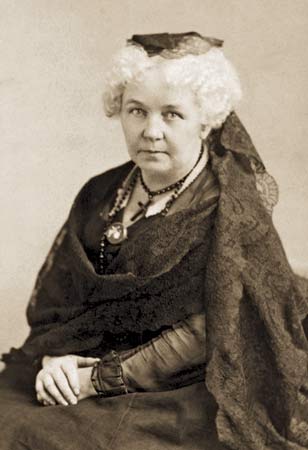
In fact, the Seneca Falls Convention grew out of sexist behavior at the 1840 World Anti-Slavery Convention in London. Women were banned from speaking or even sitting with the men. Elizabeth Cady Stanton and Lucretia Mott met and bonded over this injustice.
Public Domain, via Wikipedia Commons
Eight years later, in 1848, frustrations spilled over. Elizabeth, Lucretia, and several other women organized the Seneca Falls Convention.
300 women and men attended, and the convention issued a Declaration of Sentiments modeled on the Declaration of Independence. The most radical request was that women receive the right to vote.
The Seneca Falls Convention didn’t magically fix any problems, but it was the first convention to discuss women’s rights. It was an important step forward. Similar conventions in Rochester and Boston soon followed.
Elizabeth Cady Stanton and her colleagues would not live to see their goals fulfilled. The road to justice was long and full of humiliations and setbacks. But we wouldn’t be where we are today without them.
Why should you care about the Seneca Falls Convention?
I don’t know about you, but I like living in the 21st century. It isn’t perfect – nowhere close. But we owe a lot of thanks to the brave women and men of the past who refused to accept discrimination.
Next year I will be getting my PhD from Harvard, but if I had lived 100 years ago, that wouldn’t have been possible. Why? Because Harvard didn’t allow female students into the Graduate School of Arts & Sciences until the 1960s.
If you are a woman, I guarantee that you have done things in your life that would have been impossible at the time of the Seneca Falls Convention. Have you ever voted? Do you own property, or do you have full or partial custody of your children? Do you wear pants?
None of that was possible for Elizabeth Cady Stanton, Lucretia Mott, and the other organizers of the Seneca Falls Convention. A married woman was considered the same person as her husband – she did not even legally exist.
And that’s why Seneca Falls matters. It’s a reminder to be grateful for what we have . . . and to keep fighting for a better future. When I stood there in a tiny out-of-the-way town, I realized that it’s isn’t who you are or where you are that matters. It’s what you do.
Plan Your Visit To Women’s Rights National Historical Park
How to get to Seneca Falls
Seneca Falls is located in the Finger Lakes region of New York, between Seneca Lake and Cayuga Lake. The best way to get there is by car.
Women’s Rights National Historical Park makes a great day trip from many places in the region. Wherever you are staying in the Finger Lakes, you will likely be within an hour’s drive of Seneca Falls.
Visiting from Syracuse: Syracuse to Seneca Falls is about a 50-minute drive. There are routes with and without tolls.
Visiting from Ithaca: Ithaca to Seneca Falls is 50 minutes by car. You can take Route 89 most of the way north. It’s part of the Cayuga Lake Scenic Byway, so you’ll get some pretty views of the lake and you’ll pass lots of wineries!
Visiting from Rochester: Rochester to Seneca Falls takes just over an hour if you avoid tolls. You can save 10 minutes by paying.
Where to park in Seneca Falls
Women’s Rights National Historical Park offers limited free parking behind the visitor center. There are about 10 spots total for tourists, including one handicapped spot. Turn right onto Clinton Street just past the visitor center and the parking lot will be on your right.
I didn’t have any trouble snagging a place in the lot. But if the lot is full, you can also park on Clinton, Fall, or Mynderse Streets for up to two hours.
Things To Do At Women’s Rights National Historical Park
Women’s Rights National Historical Park includes several sites in two towns: Seneca Falls and nearby Waterloo. These sites will help you to understand exactly how the Seneca Falls Convention came about, and what its consequences were for the United States and the world.
There are four main “stops” that form part of Women’s Rights National Historical Park.
- Visitor Center (with the Waterwall outside)
- Wesleyan Methodist Chapel
- Elizabeth Cady Stanton House
- M’Clintock House (in Waterloo)
First, head to the visitor center at 136 Fall Street. The staff were very friendly and eager to give instructions. Definitely grab one of the visitor’s guides – it has a map and lots of helpful historical information.
From there you can decide what you want your route to be. The guided tours are really good, so the first thing I would do is check the tour schedule for the day. Then you can plan your trip around it.
Normally you can watch an educational film called “Dreams of Equality” in the visitor center’s theater, but the theater is currently closed due to health and safety concerns. You can watch the 20-minute film here on YouTube.
Now let’s talk about each historic location in more detail. I have arranged the attractions in the order that I think makes the most sense, but you can visit them in any sequence.
Wesleyan Methodist Chapel
Address: 136 Fall Street, Seneca Falls, NY 13148
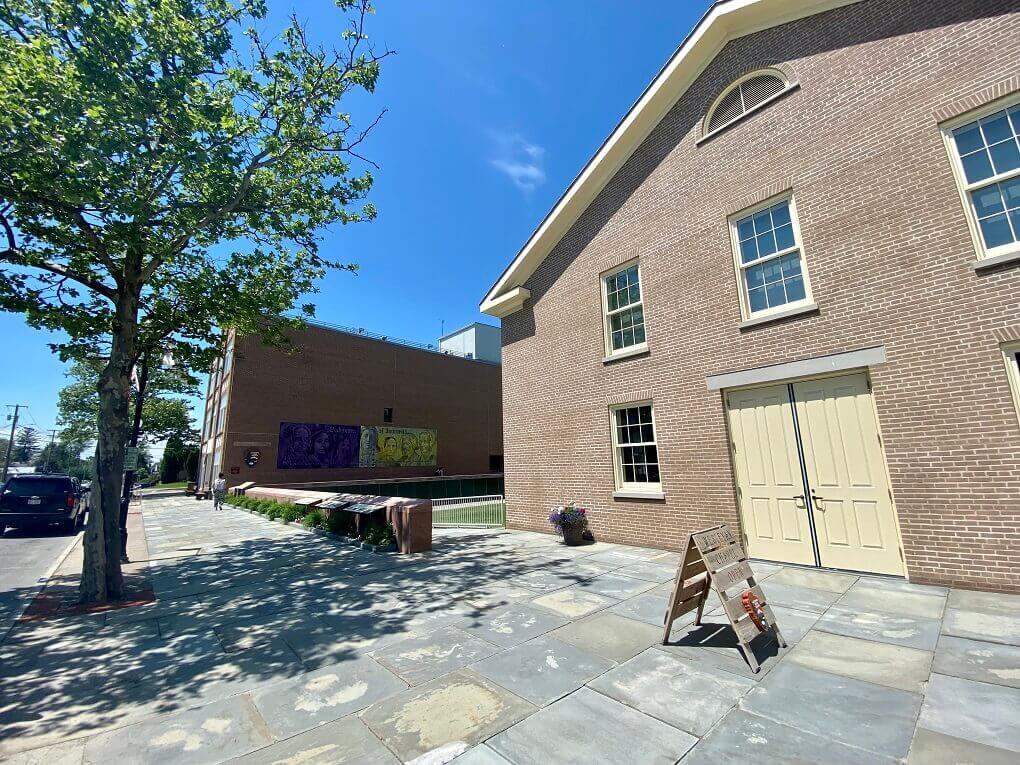
After you pick up your map, head to the Wesleyan Methodist Chapel, which is next door to the visitor center. This is the place where the women met for the Seneca Falls Convention. It was the only building that agreed to host such a “radical” meeting.
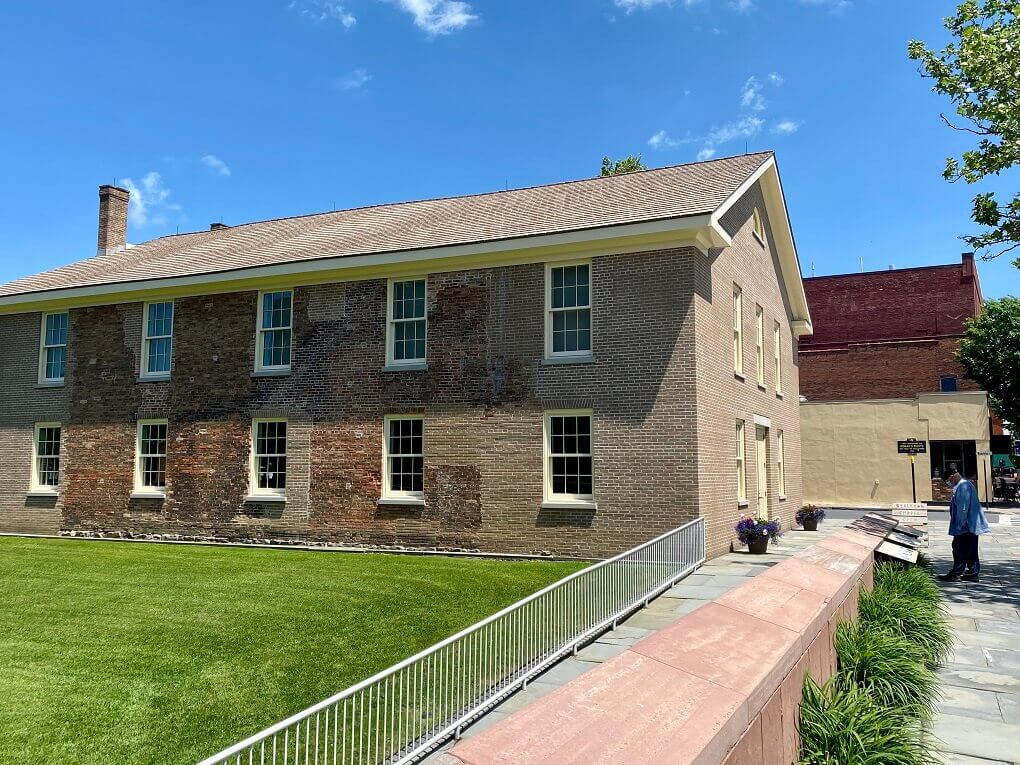
The Chapel has changed a lot in the last two centuries, but you can still see some of the original features. Interpretive panels explain the history of the building and of the historic events it witnessed.
I highly recommend that you pause here to listen to the 20-minute ranger talk, “Revolutionary Roots: the 1848 Convention.” Sit down inside the chapel as the ranger explains the background of the convention and introduces you to the major figures.
 Lucretia Mott welcoming visitors
- Inside the Wesleyan Chapel
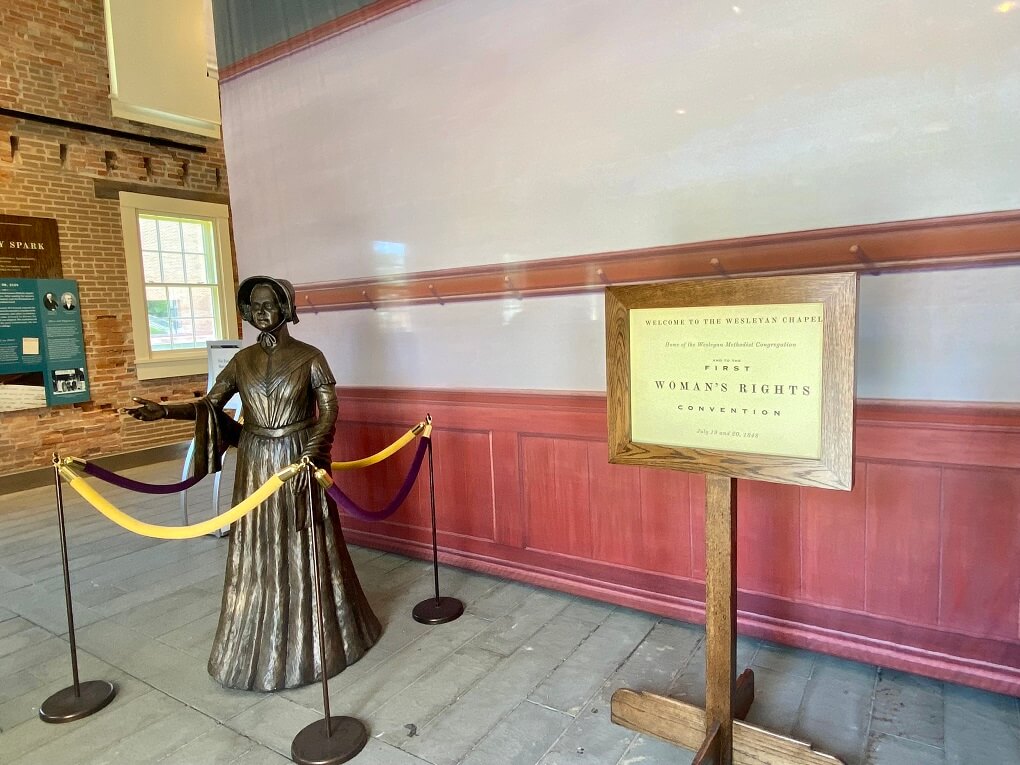
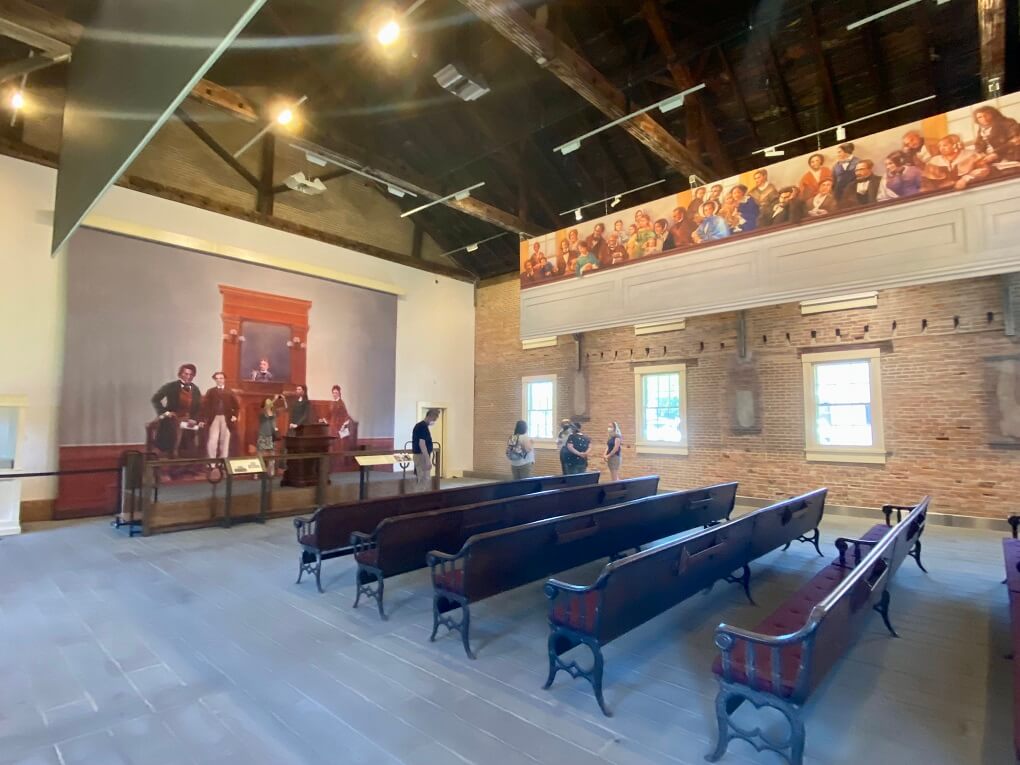
The talk focuses on the role of the Wesleyan Methodist Chapel, but it also serves as an excellent introduction to the site as a whole. Check the ranger talks schedule here.
Visitor Center
Address: 136 Fall Street, Seneca Falls, NY 13148
Once you have your bearings, head back to the visitor center to explore the museum. On the first floor you can admire “The First Wave”, a collection of life-sized sculptures depicting the major players at Seneca Falls. Today we think of Elizabeth Cady Stanton, Lucretia Mott, and their allies as “first-wave” feminists.

On the second floor of the center are exhibits about the life of 19th century women and how they set out to change things. You can learn more about the Declaration of Sentiments and public reactions to the convention.

I particularly liked the exhibit on the Haudenosaunee, better known to most Americans as the Iroquois or Five Nations. Stanton and other activists were inspired by the freedom and authority that Haudenosaunee women possessed.
I spent about an hour total in the visitor center/museum, and then I headed to the Elizabeth Cady Stanton House.
Elizabeth Cady Stanton House
Address: 32 Washington Street, Seneca Falls, NY 13148
The Elizabeth Cady Stanton House is on a quiet residential street on the opposite side of the canal from the visitor center. It is open seasonally from the end of May to the beginning of September. During that time period, there are daily ranger talks there entitled “Center of the Rebellion: the Elizabeth Cady Stanton House.”
I loved standing inside and knowing that this was where Elizabeth Cady Stanton planned with her fellow activists. Over the years she hosted such famous names as Susan B. Anthony and Frederick Douglass.
- Elizabeth Cady Stanton House
- View from the bedroom windows
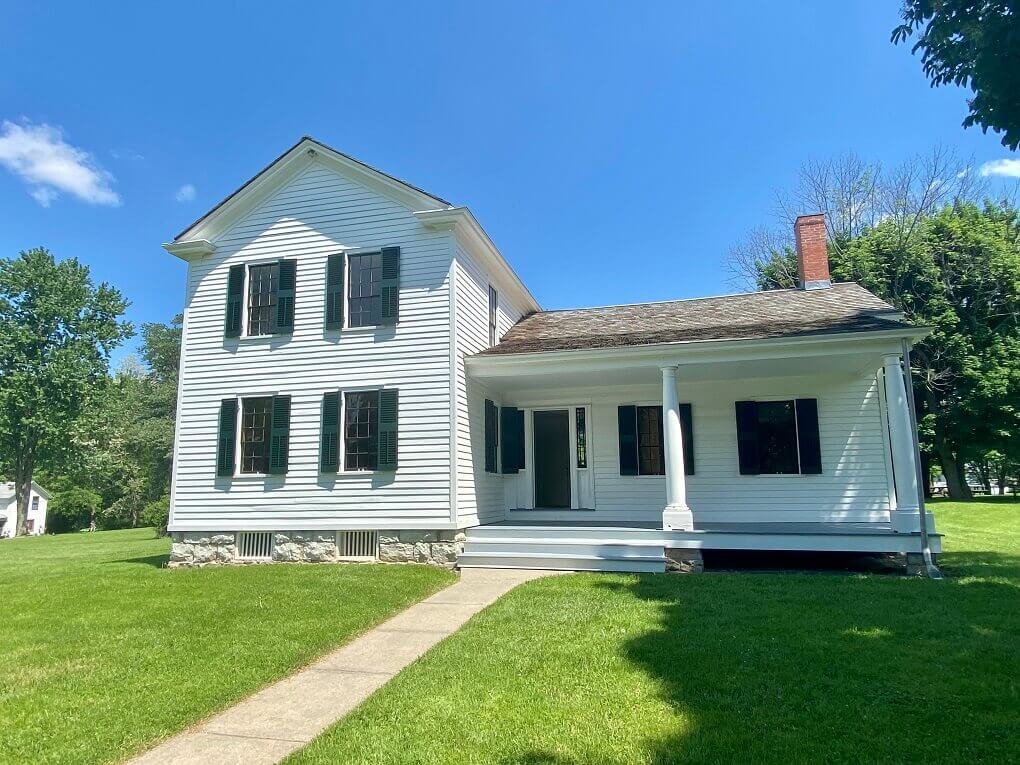

There is a small parking lot next to the house if you want to drive, but if you have the time, I recommend that you walk. It takes about 20 minutes on foot from the visitor center. The lovely route gives you a chance to see a bit more of Seneca Falls, and you pass by several significant statue groups on East Bayard Street.
“When Anthony Met Stanton” commemorates the moment when Amelia Bloomer introduced Elizabeth Cady Stanton and Susan B. Anthony. And the new “Ripples of Change” honors overlooked members of the suffrage movement.
M’Clintock House
Address: 14 E. Williams Street, Waterloo, NY 13165

NPS photo, Public domain, via Wikimedia Commons
The M’Clintock House is located one town over, in Waterloo. It is open seasonally from the end of May to the beginning of September. On Fridays, Saturdays, and Sundays, park rangers give a 20-minute talk called “Radical Hospitality at the M’Clintock Home.”
You will want to drive to this house. It’s only 7 minutes by car from the visitor center, but it would be an hour and ten minutes on foot along a highway. There is a parking lot right next door on E. Williams Street.
The M’Clintock House is famous for being the location where Elizabeth Cady Stanton and Mary Ann M’Clintock drafted the Declaration of Sentiments on July 16, 1848. Furthermore, the M’Clintocks were dedicated abolitionists, and their house was a stop on the Underground Railroad.

Public Domain, via Wikimedia Commons
Hunt House
Address: 401 East Main Street, Waterloo, NY 13165
On July 9, 1848 Jane Hunt hosted a gathering in honor of Lucretia Mott, who was visiting from Philadelphia. It was at this gathering that the women decided to organize the Seneca Falls Convention.
The Hunt House, which was built in 1829, is currently being restored and is closed to the public. The National Park Service plans to open it up for tours in the future.
In the meantime, you can drive by and admire the majestic columns on the front porch.
Final Thoughts on Women’s Rights National Historical Park
By now you have an idea of why Seneca Falls is worth a visit and what you should do there. So head to upstate New York to learn more about American history and the brave women who fought for a better future.
If you want to learn more about the Seneca Falls Convention before (or after) you go, I recommend the following book: Seneca Falls & the Origins of the Women’s Rights Movement. I am currently reading it (I bought it at the park gift shop) and I am enjoying it so far.
YOU MAY ALSO LOVE:
